
Contemporary Fossils
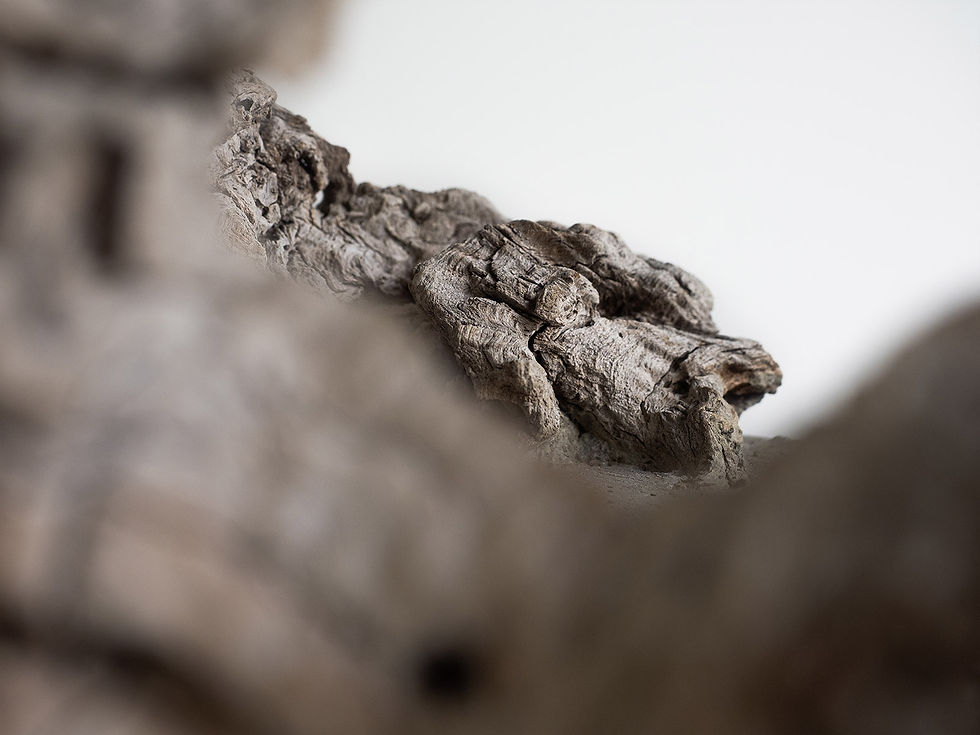
This continual process of change and response causes each tree to respond differently, resulting in incredibly minute resolutions that each resemble a specific response to a circumstance. This outcome sees each piece of wood as part of a journey, its exposure and responses to change, not only as part of the tree’s system but as it continues its life beyond its host's death.
Wood is an extraordinary material, hosting a rich diversity in characteristics. These characteristics are influenced by the type of tree and its environment, resulting in unique pattern, texture, colour, density, smell and sometimes growth. A material in a constant state of change and adaptation, stimulating trees to respond in totally different manners even when of the same species.
Discourse of matter
Contemporary Fossils
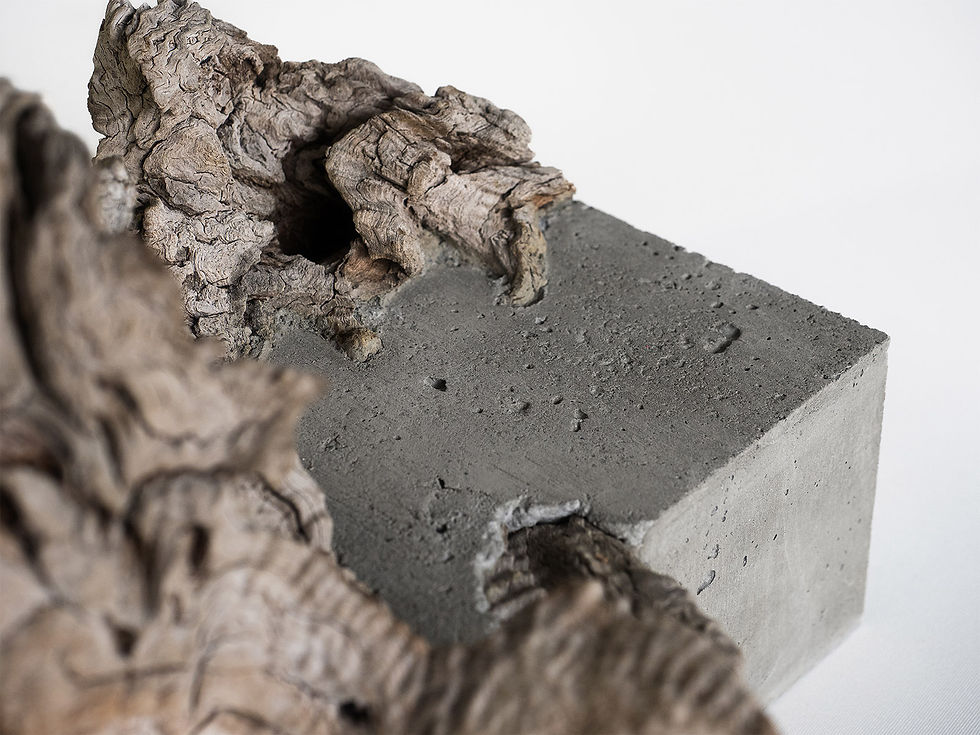
Each fossil intersects a product of natural systems directly into the rigid geometric form of a concrete block. This interaction tensions the concrete's architectural use as a contemporary stone and the organic materials discourse and formality, to create a subtle interaction that elicits an impactful response.
Contemporary Fossils is a series of natural specimens, collected from nature and solidified in concrete blocks, fossilising them. The act of isolating each specimen from its environment and the elements, capturing a moment in time; a story through the specific conditions required for each specimen to form.
Concrete however lacks crucial factors that give stone its sensitivity, presence and beauty. The wood’s rich discourse and formal qualities are juxtaposed by the mundane geometric concrete encasing it. This act of fossilisation creates a proximity between materials where neither can escape the other; a single object that draws parallels to the intersection of human made and the grown environment.
Grounded, solid, mountains and scale are all words that are that we link to stone. The presence of large stone or rocky landscapes is something that gives one a particular sensation of belonging shrouded by one's own insignificant scale. This sensitivity to stone has been replaced by the prevalence of concrete. A contemporary man-made stone, it serves as a rigid, structural material that is favoured for its weight bearing capabilities and formable liquid state.
The new age of stone?
Each specimen is then composed and an individualised vessel is constructed to surround the specimen. The panels of the vessel are sculpted to follow the contours of the wood to ensure there is no leak during the concrete pour. Once hardened the fossil is removed from the vessel.
However there is beauty in the idea that each fossil's journey continues, not in the same context or environment it had, but that its exposure and response to new ones is not prevented.
The specimens contained within the concrete blocks forming the fossil are collected from nature after their host has died. Due to their prolonged exposure to the elements, when they are collected the wood is often bleached due to the sun, appearing white or grey in complexion akin to bone. The bleached wood is often an indicator for extended periods of dryness, leaving behind hard wood that has not begun to decompose. The wood is then pressure washed to remove any soft and fragile wood, this process maintains the texture and formal qualities of the wood.
Contemporary Fossils is a series of natural specimens, collected from nature and solidified in concrete blocks, fossilising them. The act of isolating each specimen from its environment and the elements, capturing a moment in time; a story through the specific conditions required for each specimen to form.
Each fossil intersects a product of natural systems directly into the rigid geometric form of a concrete block. This interaction tensions the concrete's architectural use as a contemporary stone and the organic materials discourse and formality, to create a subtle interaction that elicits an impactful response.
Paragraph Title


Wood grain Fossil III
Wooden spine from Fossil II
Concrete texture
Wood grain Fossil III
Wooden spine from Fossil II
Concrete texture


Discourse of wood in detail
Fossil I

Texture
Layers of wood grain


Fossil III front view
Fossil III rear view


Fossil II rear view
Fossil II front view
The discourse of matter, fossilised in contemporary stone
Discourse of wood in detail
Fossil I
Contemporary Fossils is a series of natural specimens, collected from nature and solidified in concrete blocks, fossilising them. The act of isolating each specimen from its environment and the elements, capturing a moment in time; a story through the specific conditions required for each specimen to form.
Each fossil intersects a product of natural systems directly into the rigid geometric form of a concrete block. This interaction tensions the concrete's architectural use as a contemporary stone and the organic materials discourse and formality, to create a subtle interaction that elicits an impactful response.
Wood is an extraordinary material, hosting a rich diversity in characteristics. These characteristics are influenced by the type of tree and its environment, resulting in unique pattern, texture, colour, density, smell and sometimes growth. A material in a constant state of change and adaptation, stimulating trees to respond in totally different manners even when of the same species.
This continual process of change and response causes each tree to respond differently, resulting in incredibly minute resolutions that each resemble a specific response to a circumstance. This outcome sees each piece of wood as part of a journey, its exposure and responses to change, not only as part of the tree’s system but as it continues its life beyond its host's death.
Discourse of matter
Grounded, solid, mountains and scale are all words that are that we link to stone. The presence of large stone or rocky landscapes is something that gives one a particular sensation of belonging shrouded by one's own insignificant scale. This sensitivity to stone has been replaced by the prevalence of concrete. A contemporary man-made stone, it serves as a rigid, structural material that is favoured for its weight bearing capabilities and formable liquid state.
Concrete however lacks crucial factors that give stone its sensitivity, presence and beauty. The wood’s rich discourse and formal qualities are juxtaposed by the mundane geometric concrete encasing it. This act of fossilisation creates a proximity between materials where neither can escape the other; a single object that draws parallels to the intersection of human made and the grown environment.
The new age of stone?
Wood is an extraordinary material, hosting a rich diversity in characteristics. These characteristics are influenced by the type of tree and its environment, resulting in unique pattern, texture, colour, density, smell and sometimes growth. A material in a constant state of change and adaptation, stimulating trees to respond in totally different manners even when of the same species.
This continual process of change and response causes each tree to respond differently, resulting in incredibly minute resolutions that each resemble a specific response to a circumstance. This outcome sees each piece of wood as part of a journey, its exposure and responses to change, not only as part of the tree’s system but as it continues its life beyond its host's death.
Discourse of matter
Intersection of contexts

Texture
Layers of wood grain
Grounded, solid, mountains and scale are all words that are that we link to stone. The presence of large stone or rocky landscapes is something that gives one a particular sensation of belonging shrouded by one's own insignificant scale. This sensitivity to stone has been replaced by the prevalence of concrete. A contemporary man-made stone, it serves as a rigid, structural material that is favoured for its weight bearing capabilities and formable liquid state.
Concrete however lacks crucial factors that give stone its sensitivity, presence and beauty. The wood’s rich discourse and formal qualities are juxtaposed by the mundane geometric concrete encasing it. This act of fossilisation creates a proximity between materials where neither can escape the other; a single object that draws parallels to the intersection of human made and the grown environment.
The new age of stone?
The outcomes material discourse is not stagnated by the act of fossilisation, rather it seeks to capture one chapter, so we can cherish another
Fossil III front view
Fossil III rear view
The specimens contained within the concrete blocks forming the fossil are collected from nature after their host has died. Due to their prolonged exposure to the elements, when they are collected the wood is often bleached due to the sun, appearing white or grey in complexion akin to bone. The bleached wood is often an indicator for extended periods of dryness, leaving behind hard wood that has not begun to decompose. The wood is then pressure washed to remove any soft and fragile wood, this process maintains the texture and formal qualities of the wood.
Each specimen is then composed and an individualised vessel is constructed to surround the specimen. The panels of the vessel are sculpted to follow the contours of the wood to ensure there is no leak during the concrete pour. Once hardened the fossil is removed from the vessel.
However there is beauty in the idea that each fossil's journey continues, not in the same context or environment it had, but that its exposure and response to new ones is not prevented.
Fossil II rear view
Fossil II front view
Year
2024 +
Credits
All images, videos and copy, courtesy of Mineral Studio
Exhibitions: 'Mattering' Yarra Sculpture Gallery, 2026
Materials
Weathered wood, concrete, metal
Year
2024 +
Year
2024 +
Materials
Weathered wood, concrete, metal
Credits
All images, videos and copy, courtesy of Mineral Studio
Exhibitions: 'Mattering' Yarra Sculpture Gallery, 2026
Year
Materials
2024 +
Weathered wood, concrete, metal
Credits:
All images, videos and copy, courtesy of Mineral Studio
Exhibitions: 'Mattering' Yarra Sculpture Gallery, 2026